IBM Granite Time-Series Models Now Run Natively in Confluent for Real-Time Forecasting and Anomaly Detection
Time-Series Intelligence Meets Streaming Data
IBM and Confluent have integrated IBM's Granite time-series foundation models directly into Confluent's data streaming platform. The models — with more than 50 million downloads across four model variants — now run as built-in Flink SQL functions in Confluent Cloud (fully managed) and on-premises with Confluent Platform for Apache Flink. They execute on standard CPUs, eliminating the need for dedicated GPU infrastructure.
From Batch to Real-Time Decisions
Traditional time-series forecasting often arrives too late — after a production run, stockout, or payment authorization. By embedding models inside the streaming layer, Flink can prepare data, invoke forecasting and anomaly detection, and make results available alongside the events that produced them. Forecasts refresh as new observations arrive, and signals route to operational applications where teams combine them with business rules and human judgment.
Six Mission-Critical Use Cases
The integration targets practical enterprise scenarios:
- Production optimization: A pretrained TTM model reads SCADA telemetry and QA measurements every 10 minutes, forecasting the share of in-spec product four hours ahead and scoring freezer setpoint adjustments before the operator approves.
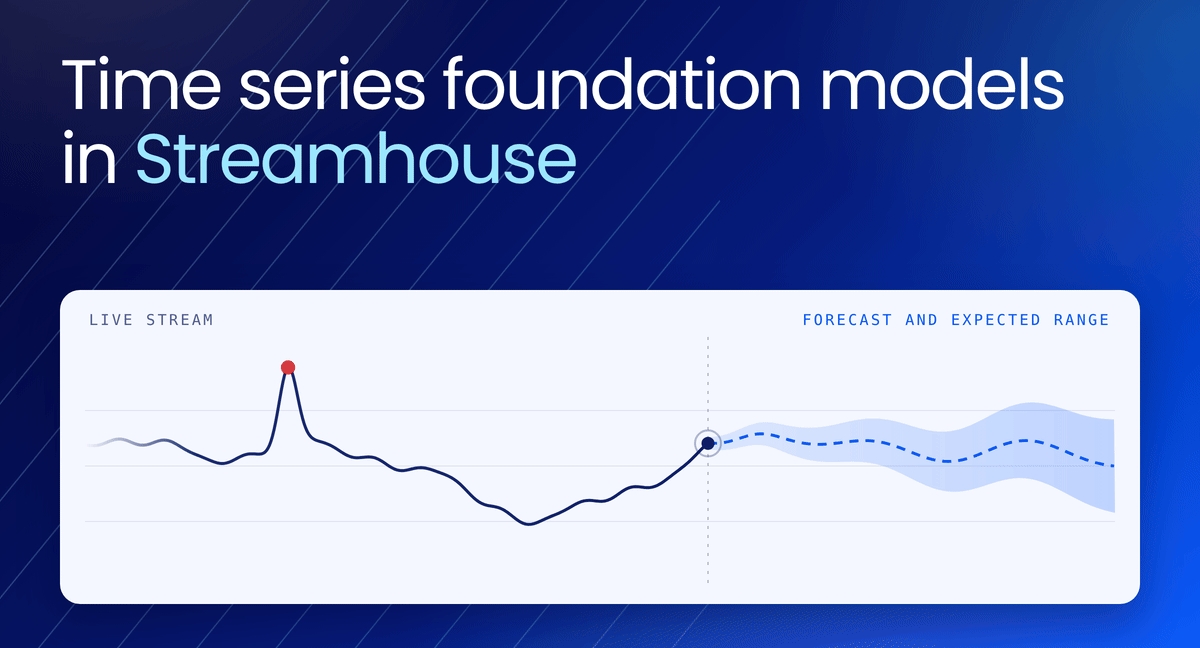
- Anomaly detection: AI_DETECT_ANOMALIES gives each sales series an expected range based on recent history, flagging only meaningful deviations — like a product selling below expectations — without training per-store models.
- Supply chain planning: AI_FORECAST produces 28-day demand forecasts with P10–P90 ranges refreshed as sales data arrives, feeding reorder points and automated purchase-order drafts.
- Fraud and security: Each payment is compared against the card's own expected spending range, adding individual context to existing fraud systems.
- Trading execution: PatchTST-FM forecasts 30-minute volume on each one-minute bar, pacing large orders within participation limits and replanning when news changes market activity.
- Semantic search: TSPulse embeddings let engineers search for similar sensor patterns — spikes, gradual rises, step changes — across equipment history to narrow investigations.
Industry Applications: From Plant Floor to Trading Desk
The same models adapt across verticals. In industrial AI, SCADA, QA, and energy streams forecast quality drift, anomaly detection catches rule-less failures, and semantic search finds precursors to pump failures. In retail, sales, weather, and promotion streams drive store-level forecasts and anomaly alerts. In banking, every card and symbol is scored against its own pattern. In airlines, engine, gate, and network streams forecast disruptions while there's still time to act.
Compact Models, CPU Deployment, Wide Access
The Granite models are small enough to run on CPUs alongside the streaming pipeline, in the cloud or on-premises. Code and notebooks are at github.com/ibm-granite/granite-tsfm. Confluent Cloud users get fully managed functions with nothing to deploy; on-premises users run them within their own infrastructure via Confluent Platform for Apache Flink.